
Why This Question Is Still Relevant?
Scroll through your phone right now. Instagram, TikTok, Google Maps… Do you really need a website on top of all that? It’s a fair question to ask: does my small business really need its own website ?Social platforms offer instant reach, and free listings provide local visibility. It can seem like a dedicated website is an unnecessary complication or a relic of the early internet.
Yet, here we are in 2026, and the most resilient, scalable, and profitable small businesses almost universally have one. Why? Because while social media is excellent for conversation and discovery, a website for a small business is the foundation upon which lasting digital presence is built for trust and engagement. This isn’t just following the crowd. It’s about making a move that actually makes sense for your business.
We won’t convince you to build website. We will provide analysis of pros, cons, costs and real-world impact and give you a simple checklist. We’ll tackle the common fears head-on and give you a clear framework to decide: Is a website a worthwhile asset or an unnecessary expense for your specific business? Let’s move beyond the hype and look at the facts.
Myths vs. Reality: The 3 Biggest Fears About Websites
Before diving into the benefits, let’s break down the three most common fears that stop business owners from building their own webpage. These myths are common, but understanding the reality behind them is the first step toward making an informed decision.
Myth 1: “Social media is enough for us.”
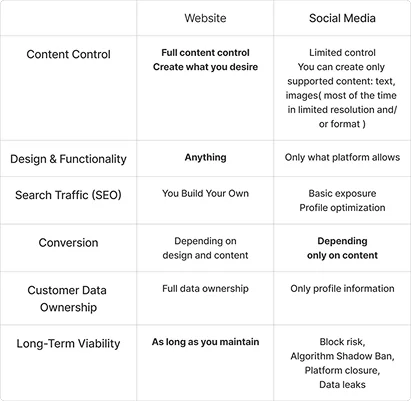
Think of social media as renting a booth at a busy, ever-changing market. You have great visibility, but the landlord (the platform) controls the rules, the audience’s flow, and can evict you or change your rent (algorithm or platform rules) at any time. A website, however, is your owned property. It’s a permanent digital storefront that you fully control. You are not at the mercy of an algorithm deciding not to show your posts or the risk of an account suspension. A website is your stable, secure home base and social media are your outreach channels that should ultimately drive traffic back home.
Myth 2: “It’s too expensive and complicated.”
A decade ago, this had more truth. Today, the landscape is entirely different. The cost to build a website ranges from a few dollars a month for a simple DIY builder (like Wix or Readymag) to a larger investment for a custom, professionally developed site. The complexity directly correlates with your goals. A basic online brochure is straightforward; a multi-language e-commerce platform is not. Don’t overcomplicate it. Pick the right tool for the job you have right now. For many small businesses, starting simple and scalable is not only affordable but a smart strategy.
Myth 3: “I don’t have the time to manage it.”
This concern stems from the image of needing to code daily updates. Modern Content Management Systems (CMS) like WordPress or user-friendly builders have revolutionized this. Updating text, images, or adding a blog post is often no more difficult than creating a post in social media — and sometimes easier. In fact, with a clear initial structure, basic maintenance for a small business site often requires less frequent effort than the daily grind of creating content for multiple social media algorithms. The question isn’t about having time; it’s about prioritizing a long-term asset over short-term engagement.
The Undeniable “PROS”:When a Website Becomes a Growth Engine
Once we move past the fears, the strategic advantages of a website become crystal clear. For a small business, it’s far more than a digital business card. A good website isn’t just a brochure. It’s a salesperson, a receptionist, and a brand ambassador all in one.
Trust & Legitimacy: Your Digital Office
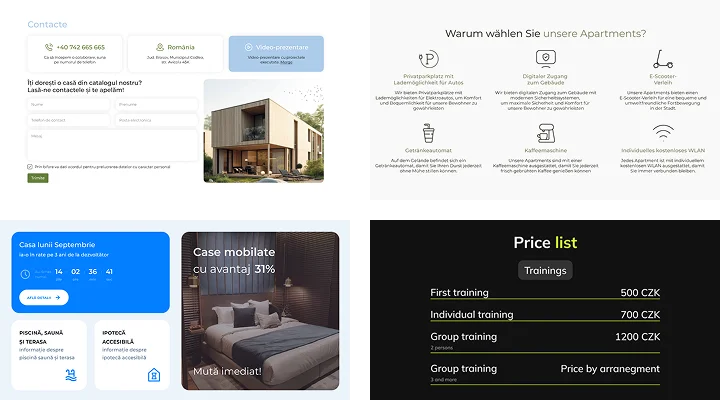
Before picking up the phone or walking into a store, what does a potential client do? Usually, they search online. A professional website acts as your “digital office.” It’s where first impressions are formed. A sleek, informative site signals that you are established, credible, and invested in your profession. It answers critical questions before they’re even asked. Conversely, not having a website or having an outdated website can raise doubts about your legitimacy or the scale of your operations. More about how to build appealing and converting website you can find out in our article “The Perfect Landing: how to build your website”
The 24/7 Salesman & Lead Machine
Your business has closing hours, but the internet does not. A website as a 24/7 salesman works while you sleep. It can capture leads through contact forms, sell products directly via an online store, book appointments through integrated calendars, and answer FAQs through a dedicated section. It converts organic search traffic from Google (people actively looking for what you offer) and paid traffic from ads into tangible business opportunities, 365 days a year.
Full Control Over Your Content & Branding
On social media, you are constrained by character limits, fleeting feed formats, and the platform’s aesthetic. Your website is your blank canvas. You control the narrative, the design, the user journey, and the branding from start to finish. You can publish long-form articles, host videos, create interactive tools, and design an experience that perfectly reflects your brand’s unique personality—without competing with cat videos or political rants in a user’s feed.
The Central Hub for All Marketing Activity
Every piece of marketing you do should have a destination. Your Google Ads, Facebook campaigns, Instagram bio link, email newsletter, and even your business card should all point to your website. Your website is where all your online efforts should lead — it’s the heart of your digital presence. where you can deeply engage visitors, capture their information, and guide them toward a conversion. It’s the only place where you own the entire customer journey from first click to final action.
A Critical Competitive Edge
Finally, it’s a simple matter of competition. If two local cafes are side-by-side in search results, one with a beautiful website showing its menu, ambiance, and customer reviews, and the other with only a sparse Google listing, which one will get the click? In a competitive market, not having a website means ceding ground. It means losing potential clients at the very last step of their decision-making process. A strong website isn’t just an asset; it’s a competitive advantage of a website that helps you stand out and win.
The Honest “CONS”: When You Can (Temporarily) Manage Without One
To maintain complete objectivity, it’s crucial to acknowledge that a website isn’t an absolute, day-one requirement for every single venture. There are a few scenarios where dedicating resources to a website upfront might be premature. Recognizing these can save you from an unnecessary early expense.
Scenario 1: You’re only Testing a Business Hypothesis
If you’re literally validating whether a service or product has any market demand, your focus should be on the leanest Minimum Viable Product (MVP). This could mean taking orders via a simple Instagram DM or a WhatsApp group. The goal here is to confirm people will pay, not to build a perfect digital facade.
Scenario 2: Your Entire Market Exists in a Single, Closed Ecosystem
Some hyper-niche, community-driven businesses (e.g., a specialized crafting group, a local club) might function entirely within a Facebook Group or a Telegram channel where all their clients and discussions already live. For them, a separate website might be an extra step with little immediate ROI.
Scenario 3: You Have Zero Resources for Maintenance (and it’s a conscious choice).
A neglected, outdated website is worse than no website at all. If you genuinely have no capacity —not even an hour a month — to update contact info or check the hosting is live, then launching a site sets you up for a digital ghost town that erodes trust.
Important Warning: These are temporary states. They describe the very beginning of a journey or a uniquely constrained model. The moment you answer “yes” to wanting more clients, scaling beyond your immediate network, or looking professional, these exceptions expire. The question shifts from “can you run a business without a website” temporarily, to “how long can you afford to before it holds you back?”
Practical Workshop: Assess Your Business Need in 5 Minutes
Theory is useful, but a decision about your business requires your context. Let’s move from abstract to personal with this quick diagnostic workshop. Take 60 seconds. Ask yourself these four questions.
Question 1: Where do your clients find you right now?
- A) Primarily through word-of-mouth or in-person.
- B) On my social media profiles or a marketplace (like Etsy/Fiverr).
- C) They Google for services like mine.
Question 2: Do you find yourself repeatedly explaining the same basics about your services, prices, or process?
- A) Constantly. It takes up a lot of my time.
- B) Sometimes, but I have some saved messages/photos.
- C) Rarely, everything is already documented somewhere.
Question 3: Would you like to receive inquiries, leads, or even sales while you’re asleep, on vacation, or simply focused on other work?
- A) Absolutely, that would be a game-changer.
- B) It would be nice, but not critical.
- C) No, I prefer to control when I’m available.
Question 4: Do you have any plans to grow, scale, or expand your business in the next 1-2 years?
- A) Absolutely, that would be a game-changer.
- B) It would be nice, but not critical.
- C) No, I prefer to control when I’m available.
Interpreting Your Answers:
If you have two or more answers in the ‘A’ or ‘B’ categories for Questions 1-3, or an ‘A’ for Question 4, a website is not just a “nice-to-have”—it’s a strategic tool to solve real bottlenecks (time, visibility, scaling). It directly addresses the pains you’re experiencing.
If most answers are ‘C’, you might fit the “temporary exception” category we discussed. However, revisit these questions every 6 months; your answers will likely change as your business evolves.
Step-by-Step Action Plan: Where to Start If You’re Convinced
You’ve weighed the pros and cons, and the assessment points toward “go.” Excellent. Now, let’s demystify the process. Creating a website is a project, not a mystery. Follow this clear, no-fluff website creation plan to go from idea to launch without overwhelm.
Step 1: Define Your Core Goal with One Sentence
Everything flows from this. Be brutally simple: “I need a website to…sell my handmade candles online,” “generate qualified leads for my accounting services,” or “provide information and build credibility for my physiotherapy clinic.” This goal dictates every decision that follows.
Step 2: Choose the Type & Technology That Fits Your Goal
This is where you match the tool to the task.
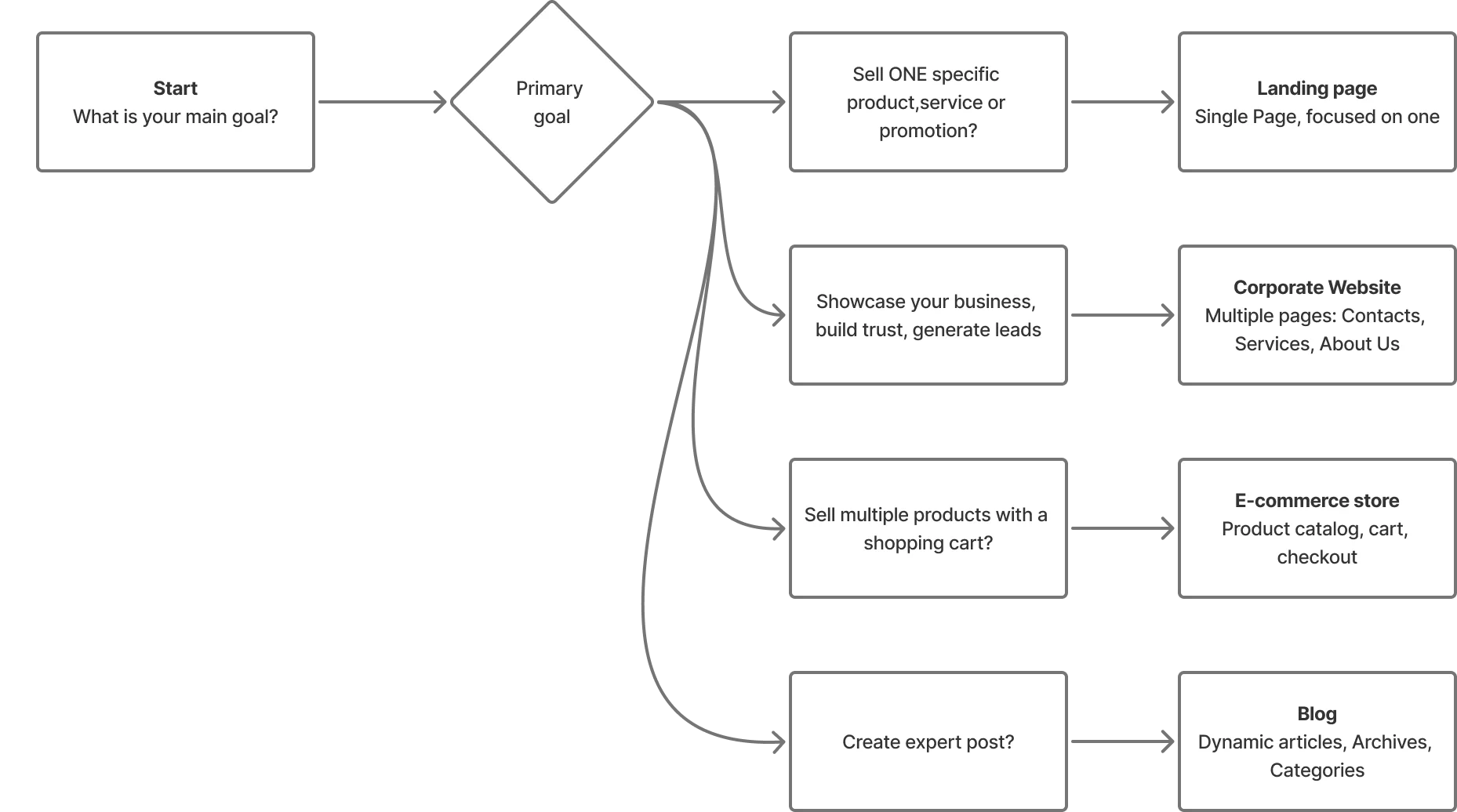
- Type: Is your goal singular (sell one course, book consultations)? A Landing Page might suffice. Explaining a multi-faceted business? A Multi-page Website is better. Selling physical/digital goods? You need an E-commerce Store.
- Technology: For most non-technical small business owners, the choice is between a Website Builder (Wix, ReadyMag) and a Content Management System (CMS) like WordPress.
- Builders are all-in-one, easier for DIY, but can be limiting for growth.
- WordPress is vastly more powerful and flexible, the engine behind 43% of the web, but has a steeper learning curve or requires a developer.
Step 3: Plan Your Structure & Core Content (The Mini-Checklist)
Before design, plan your pages. Every small business site should consider these essentials:
- Homepage: Your value proposition front and center.
- Services/Products Page: What you offer, clearly.
- About Page: Your story, why you’re different.
- Contact Page: Phone, email, a form, and a map.
- Legal Pages: Privacy Policy, Terms of Service.
Step 4: Find a Contractor or Decide to DIY.
DIY (Builders):
Pros: Lower upfront cost, full control.
Cons: Time investment, limited by templates, you’re responsible for everything.
Hire a Professional (like we are)
Pros: Saves you time, expert result, technical handling, strategic input.
Cons: Higher initial investment. To choose wisely, come prepared with questions.
We also cover this topic in a separate article: “Code vs. Builder: Which is better for creating websites?”
Step 5: Launch & Promote, Don’t Just Publish.
- Basic SEO: Submit your sitemap to Google Search Console. Ensure page titles and descriptions are clear. Learn more about SEO in our article “Is SEO Magic? Spoiler: No. Here’s How It Actually Works”
- Analytics: Install Google Analytics (GA4) from day one to understand your visitors.
- Connect to Marketing: Link to it from all your social profiles. Use it as the destination for any ads.
This step-by-step guide on how to create a website for a small business breaks down a daunting project into manageable tasks. The hardest part is starting with a clear goal—the rest is execution.
Conclusion: A Website as an Investment, Not an Expense
What if we looked at this differently? A website isn’t a cost — it’s an investment in your business’s future. The long-term view reveals its true nature: a digital asset. It’s a system that, once established, works continuously to reduce your operational burdens — like repetitive explanations and missed after-hours inquiries — while actively creating new revenue channels through lead generation and sales.
The initial effort or investment is not an expense; it’s capital allocated to building an owned, scalable platform for your business growth. In a digital-first economy, a professional online presence is no longer a luxury for the few but a fundamental tool for the many.
Ready to transform your online presence from a question mark into
your most reliable business asset?