
Introduction: The Sound of the Hype Machine
Open any social media feed, and it’s there. Scroll through your emails, and it’s there. Watch a video on YouTube, and right before the content you actually wanted to see, an ad promises to build you a professional website in under a minute — without a designer, without a developer, and certainly without the budget you thought you needed.
“Just describe your business, and watch AI do the magic.”
It sounds like the dream, doesn’t it? For a small business owner juggling inventory, clients, and paperwork, the idea of skipping the entire complex world of web development and jumping straight to a finished site is incredibly seductive. Why spend weeks briefing an agency, reviewing mockups, and discussing color palettes when an algorithm can assemble something “good enough” while you make coffee?
It’s a fair question. And it’s exactly why we need to have this conversation.
But here’s the thing about bubbles — whether we’re talking about tulips in the 17th century or crypto more recently. They feel real while you’re inside them. The hype drowns out the skepticism. Everyone around you seems to be buying in, and the fear of missing out becomes louder than the voice asking, “Wait, does this actually work for my business?”
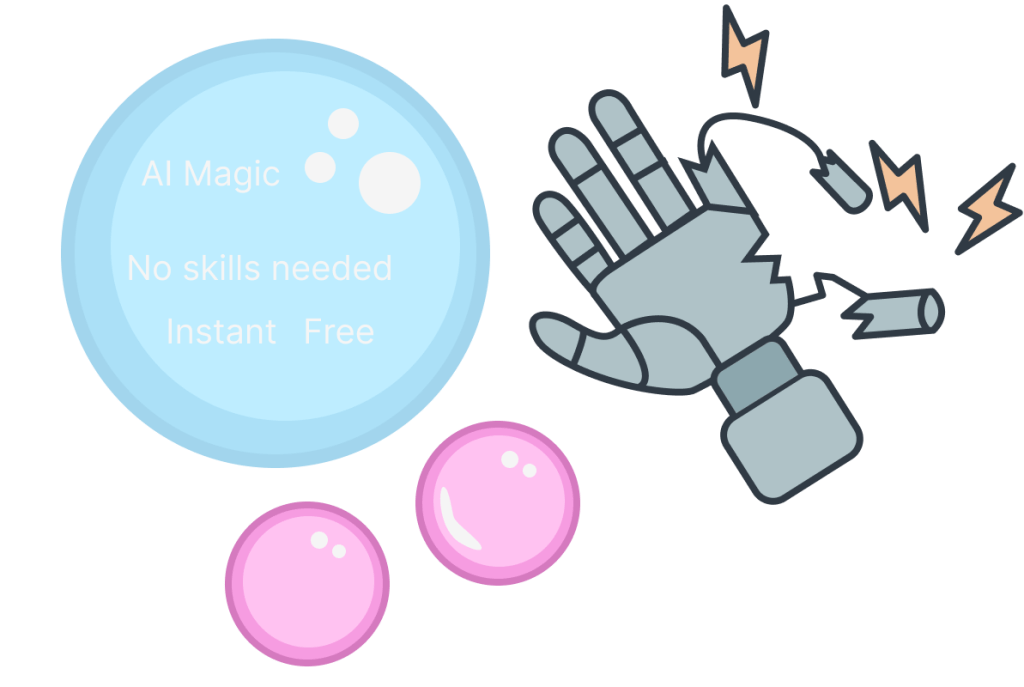
We’re not here to tell you that AI is evil, or that you should bury your head in the sand and ignore technological progress. That would be foolish. What we are here to do is what any good partner should do: help you separate the signal from the noise. To look at the AI revolution in web development not through the lens of tech blogs trying to generate clicks, but through the lens of your business goals.
Does a website built by AI become a genuine asset that grows your brand, generates leads, and earns trust? Or does it become a digital gamble — one where you save a few dollars upfront but pay for it later in invisible search results, broken updates, and missed opportunities?
Let’s step outside the hype for a moment and look at the facts.
What the AI Hype Promises (And Why It’s Seductive)
To understand why so many business owners are tempted by AI website builders, we have to first acknowledge that the promise is genuinely appealing. The marketing machines behind these tools are brilliant — not because they deceive, but because they speak directly to the pain points that every entrepreneur feels.
The Promise of Speed
Time is the one resource you can’t make more of. So when a tool tells you it can take you from a blank screen to a published website in the time it takes to watch a TV show episode, it’s hard not to lean in. The traditional process of professional web development — discovery, architecture, design, content creation, development, testing, launch — can take weeks or months. An AI builder compresses that into minutes. For someone who needs “something online right now,” that speed feels like a lifesaver
The Promise of Low Cost
Let’s be honest: hiring a professional web design agency is an investment. It’s not an expense you check off lightly. When an AI tool offers a site for twenty dollars a month — or worse, for free — it bypasses all the budget discussions, the proposal reviews, the internal justification. It removes the friction of asking, “Can we afford this?” The price tag is so small that it barely registers as a decision. And that’s precisely the point.
The Promise of “Good Enough” Design
There’s also a quieter, more subtle promise at play here: the promise that you don’t need to be a designer to look like one. The AI has analyzed millions of websites. It knows what works. It knows current trends. It can generate a color palette, pick fonts, and arrange content in a way that, at first glance, looks clean and modern. For a business owner who feels intimidated by the world of design, this feels like handing the keys to a professional—even if that professional is just a very sophisticated pattern-matching machine.
The Honest Reality Check
Here’s where we need to pause and breathe.
For some extremely narrow situations, this might actually be enough. If you’re throwing together a quick landing page for a one-time weekend event, and you genuinely don’t care if it converts or ranks — you just need a digital flyer — then sure, an AI builder might get the job done. If you’re testing a raw business hypothesis and want to see if anyone clicks a button before you invest a cent, it’s a low-stakes experiment.
But for a business? For something that represents your brand, your reputation, your credibility? The bar is higher. Much higher.
Because a business website isn’t just a page on the internet. It’s your most valuable digital real estate. It’s where potential clients decide whether to trust you. It’s where your story comes to life. It’s the anchor for every piece of marketing you’ll ever do—your Google ads, your social media profiles, your business cards, your email signature. Everything points to your website.
And that’s precisely why building it on a foundation of hype and shortcuts is a gamble most business owners don’t realize they’re taking.
The Three Things AI Doesn’t Understand About Your Business
To understand why an AI-built website is a gamble, we need to look beneath the surface. Because a website isn’t just a collection of pages. It’s a tool designed to do one thing: help your business grow. And growth requires strategy, emotion, and technical precision — three areas where AI, for all its hype, remains fundamentally blind.
1. Strategy and User Intent
Imagine walking into a physical store. You have a question about a product, and instead of a salesperson, you’re handed a brochure that sort of, kind of, answers what you asked. The text is vaguely related, the layout is generic, and nothing about the experience makes you feel understood. You’d probably leave.
This is what AI does to your website visitors.
AI can generate text based on prompts. It can arrange blocks based on patterns. But it cannot step into the mind of your specific customer. It doesn’t know that your clients are usually in a hurry, or that they’re skeptical after being burned by cheap providers, or that they need to hear a particular phrase to feel safe reaching out. AI fills space. It doesn’t design a journey.
Professional web development starts with a question: “What does this person need to feel, know, and trust before they’re ready to buy?” Every element on a professionally crafted site—the headline, the images, the button colors, the order of information — exists to guide that person toward a decision. It’s psychology, not just pixels.
AI doesn’t do psychology. It does patterns. And patterns, by definition, are average. Is average good enough for your business? We believe it’s not, your business is exceptional.
2. Brand Soul and Differentiation
Here’s a question: if you swapped your logo with your top competitor’s logo, would your website still look like it belongs to them?
If you’re using an AI builder, the answer is probably yes.
AI is trained on what already exists. It looks at millions of websites and learns what’s “normal.” It then assembles your site from the most common, most statistically frequent elements. The result? A site that looks clean, modern, and exactly like thousands of other sites built by the same tool.
Your brand, however, is not supposed to look like everyone else. Your brand is the sum of your story, your values, your voice, your weird quirks, your specific way of solving problems. It’s what makes a client choose you over the faceless competitor down the street.
A human designer doesn’t just arrange content. They interpret your story and translate it into a visual language. They make choices — sometimes unconventional ones — that signal to your audience: “We’re different, and here’s why that matters to you.” AI can’t make those choices. It can only remix the past, and the past is crowded with average.
3. The Technical Foundation for Growth (SEO and Stability)
This is the quiet killer. The one you don’t notice until it’s too late.
AI-generated websites often look fine on the surface. But beneath the hood, the code can be a nightmare. Bloated. Redundant. Structurally chaotic. It’s code written by a machine that doesn’t care about tomorrow.
Why does this matter? Two reasons.
First, SEO. Search engines like Google send “crawlers” to read your site’s code and understand what it’s about. They look for clean structure, semantic headings, fast loading times, and logical hierarchies. When your code is a mess, the crawlers get confused. They might not index your pages correctly. They might penalize you for slow speed. The result? Your beautiful site simply doesn’t appear when potential clients search for your services. It exists, but it’s invisible.
Second, stability. Remember that AI builder that promised you could update things yourself? Try changing a headline six months later and watch the layout collapse. Try adding a new page and see the navigation break. Because the code wasn’t written with human maintenance in mind, every small change becomes a landmine. You end up with a site you can’t touch, or worse, a site that slowly falls apart as you try to grow it.
A professional development team builds for the long term. Clean, semantic code that search engines love. Structured data that helps you rank. A content management system that actually lets you manage content without breaking things. It’s not just building a site; it’s building a foundation that can support your business for years.
Client Story: The Shiny AI Experiment That Backfired
Let’s make this real. Not with theory, but with a story.
A few months ago, a consultant — let’s call him Jack — reached out to us. He was frustrated, a little embarrassed, and frankly tired of explaining his situation to people who couldn’t help. We asked him to walk us through what happened.
Jack runs a boutique financial advisory practice. He helps small business owners make sense of their numbers. When he decided it was time for a professional website, he did what any sensible person does: he researched options. He looked at agencies (including ours), looked at freelancers, and looked at the growing wave of AI website builders.
The AI builder won.
Not because it was better, but because the promise was so seductive. “Describe your business, and we’ll build your site in minutes.” Jack typed in a few sentences about his services, picked a color scheme the AI suggested, and within an hour, he had a published website. It looked clean. It looked modern. It looked, to his eye, like what a “real” site should look like. Total cost? Practically nothing compared to an agency quote.
For the first month, Jack was satisfied. He had a digital presence. He could send people a link. It felt like progress.
Then reality arrived.
First, the silence. Jack expected his phone to start ringing. He’d invested in the site, after all. But the calls didn’t come. Leads didn’t trickle in. The site was live, but it felt like a billboard in the desert—visible only to those who already knew where to look.
Second, the breakdown. Jack wanted to add a blog post. He’d read that content helps with SEO, so he wrote an article and logged into his AI builder to publish it. The process was clunky, but he managed. Except the layout shifted. The formatting on his homepage changed. A block of text now overlapped an image. He tried to fix it and made it worse.
He looked for help. Upwork, Fiverr, local developers. The responses were discouraging. “The code is a mess.” “I’d have to rebuild from scratch.” “It’s cheaper to start over than fix this.”
Third, the audit. By the time Jack came to us, he was deflated. We ran a quick diagnostic on his site— the kind we do for free because we believe in transparency. What we found was predictable, but still painful to see.
The site had no semantic structure. Headings were randomly assigned. Images weren’t optimized, dragging load times into the red zone. There were no meta descriptions, no alt text, no schema markup. The content was so generic — generated by AI, of course — that it could have belonged to any financial advisor in any city. It answered none of the specific questions that Jack’s ideal clients were actually typing into Google, like “How do I reduce taxes for my small business” or “What financial records do I need to keep.”
In short, Jack had a website that looked fine to the human eye but was invisible to search engines and impossible to maintain. He’d saved money upfront and was now facing a rebuild that would cost more — in both time and money — than if he’d invested properly from the start.
The good news? We rebuilt his site. Clean code. Clear strategy. Content that actually answered his clients’ questions. Today, his site ranks on the first page for his core services he provides in the town, and the phone rings regularly.
The lesson isn’t that AI is evil. It’s that tools have purposes. A hammer is excellent for nails, terrible for brain surgery. An AI builder might be fine for a temporary project, but for your business — your reputation, your future — you need something built by people who understand what they’re building and why.

The AI Bubble: Where AI Actually Belongs (Spoiler: Not in the Driver’s Seat)
By now, you might be expecting us to say that AI is useless, or that any business using AI tools is cutting corners. That’s not the argument we’re making. The argument is about placement. About who or what holds the steering wheel.
Because here’s the honest truth: AI is not the enemy of good web development. It’s just not the leader of it either.
Think of it this way. A professional chef has access to all kinds of technology. Immersion circulators for precise cooking. High-powered blenders. Industrial ovens with computer-controlled humidity. These tools are incredible. They save time, increase consistency, and open up creative possibilities. But no one walks into a Michelin-starred restaurant and says, “Wow, your oven really outdid itself tonight.” The oven is a tool. The chef is the artist.
This is where the current AI bubble gets it backwards. The tools are being marketed as the artist. “Let AI design your brand.” “Let AI write your content.” “Let AI build your site.” It’s like handing the oven a menu and asking it to cook.
Where AI Actually Helps
In the hands of a skilled professional, AI can speed up certain parts of the process. It can generate a list of headline variations for a copywriter to refine. It can suggest color palettes that a designer might not have considered. It can help brainstorm content ideas based on what’s already working in your industry. These are genuinely useful applications. They turn AI into what it should be: a smart assistant, not a decision-maker.
But notice what’s missing from that list. AI isn’t making strategic choices. It isn’t deciding which message will resonate with your specific audience. It isn’t balancing the competing needs of brand identity and usability and SEO and conversion optimization. Those decisions require something AI doesn’t have: context. Lived experience. Empathy. The ability to look at a blank page and imagine not just what could be there, but what should be there for the person who will arrive six months from now with a problem to solve.
Imagine you’re planning a road trip. You pull out your GPS, type in the destination, and it shows you a route. Helpful, right? Now imagine you ask that same GPS to not just show you the route, but to build the road while you drive. To lay the asphalt, install the guardrails, paint the lines, and put up the signs — all in real time, under your wheels.
It’s just impossible. You’d never ask that of a GPS.
Yet that’s exactly what happens when you ask an AI builder to create your business website. You’re asking a navigation tool to do the work of engineers, architects, and construction crews. The result isn’t a road you can drive on for years. It’s a bumpy path that ends abruptly, usually at the worst possible moment.
AI belongs in the passenger seat, offering suggestions and handling small tasks. It does not belong behind the wheel. And it certainly doesn’t belong in the driver’s seat of your business’s most important digital asset.
Practical Workshop: How to Spot a “Bubble” Website
Let’s get practical. Whether you already have a site built by an AI tool, or you’re considering one, or you’re simply wondering if your current site is quietly underperforming, this workshop is for you.
Grab a notepad, open your website in a browser, and run through these four tests. They’ll take about five minutes total, and they’ll tell you more about your site’s health than most marketing presentations will.
Test 1: The “Broken” Test
Log into your site’s backend. Find a piece of text — any text — and change one line. Maybe your tagline, maybe a heading. Save it. Now look at your site on the front end.
What happened?
If the layout shifted, if images overlapped text, if the menu suddenly looked wrong, you’ve failed this test. A professionally built site should handle simple text changes with grace. It should be stable, predictable, forgiving. If your site breaks when you breathe on it, you don’t own your website. You’re renting a house of cards.
Test 2: The “Generic” Test
Read your homepage out loud. Better yet, have someone else read it — someone who doesn’t know your business.
Does it sound like you? Does it capture your specific way of talking about your work? Or does it sound like it could belong to any of your competitors?
AI-generated content tends toward the average. It uses safe phrases, common structures, and broad statements that could apply to anyone. “We provide high-quality services to meet your needs.” “Customer satisfaction is our priority.” “We help businesses grow.” These sentences aren’t wrong. They’re just empty. They don’t stick. They don’t differentiate.
If your site sounds generic, it’s not working as hard as it should. A website’s job is to make you memorable. Generic is forgettable.
Test 3: The “Speed” Test
Open Google’s PageSpeed Insights. It’s free and takes thirty seconds. Enter your website URL and let it run.
Look at the scores for mobile and desktop. Look especially at the Core Web Vitals — these are metrics Google uses to evaluate user experience.
If your scores are in the red or yellow zone, you have a problem. Slow sites frustrate visitors and rank lower in search results. Google explicitly prioritizes fast-loading sites. If yours is sluggish, you’re invisible by design.
AI-generated code is notoriously bloated. It often loads unnecessary scripts, compresses images poorly, and creates inefficient structures that slow everything down. Speed isn’t just a technical nicety. It’s a business metric. Every second of delay costs you visitors, trust, and sales.
Test 4: The “Findability” Test
Open an incognito or private browsing window in your browser. This ensures your search history doesn’t skew the results. Now search for the thing you do, plus your city or district. “Financial advisor [your city].” “Plumber [your city].” “Boutique hotel [your district].”
Where are you?
If you’re not on the first page, you’re not in the game. 85% of users never make it to page two. If you’re not there, your competitors are getting the calls you should be getting.
Now try searching for something more specific — a problem your clients have that you solve. “How to reduce small business taxes.” “Signs your roof is leaking.” “What to pack for a safari.” This is called long-tail search, and it’s where intent is highest. People searching specific problems are closer to buying. If you’re not answering those questions on your site, you’re missing the people who are actively looking for you.
What Your Results Mean
If you failed any of these tests, don’t panic. Most sites — especially those built quickly or cheaply —fail at least one. The question isn’t whether your site is perfect. It’s whether you’re willing to let it underperform.
The good news is that every problem we’ve discussed is fixable. Clean code can replace bloated code. Clear strategy can replace generic content. SEO can be rebuilt from the ground up. But fixing requires one thing: acknowledging that the tool you used wasn’t up to the job.
Your business deserves better than a bubble website. It deserves a foundation
The Alternative: The Human-Driven Approach
So if AI builders aren’t the answer for a serious business website, what is? The answer is simpler than the hype would have you believe: skilled humans doing what they do best, with clean tools and clear communication.
At our agency, we’ve built our entire process around two beliefs. First, that your website deserves the attention of real experts who care about the outcome. Second, that working with an agency shouldn’t mean endless calendar invites and scheduling headaches.
How We Work (Without the Calendar Chaos)
We’ve learned something over the years: most business owners don’t want more meetings. They want results. They want to move forward without blocking out hours of their week for status calls that could have been emails.
That’s why our process is built around text-first communication.
1. Discovery & Strategy (Text-First)
Every project starts with understanding. But understanding doesn’t require a 45-minute Zoom call where we all introduce ourselves and fight with unstable Wi-Fi.
Instead, we send you a thoughtful questionnaire. Or we open a shared document. Or we simply chat in messages — whatever medium you prefer. You answer when you have time. Between client meetings, late at night, early in the morning, during your coffee break. No rushing, no “let me find a slot next Tuesday.”
We ask about your goals, your clients, your competitors, your vision. We dig into what makes your business different and what kind of experience you want your visitors to have. By the time we’re done, we know you — not because we watched you on camera, but because we listened to what you actually said, in writing, at your own pace.
2. Custom Design & Architecture
With that foundation, our designers go to work. Not by asking an AI for a template, but by thinking. By sketching. By considering your specific audience and what will resonate with them.
Every element is placed with intent. The order of information, the hierarchy of headlines, the flow from section to section—all of it exists to guide your visitor toward a decision. This isn’t assembly-line design. It’s craft.
3. Clean Development & SEO Foundation
When the design is approved, our developers build. Clean, semantic code that search engines can read effortlessly. Fast-loading pages that respect your visitors’ time. Structure that won’t collapse when you want to add a new service or update a blog post.
SEO isn’t an afterthought here. It’s built into the foundation. Heading structures, meta data, schema markup, site architecture — everything is optimized from day one, not sprinkled on later like fairy dust.
4. Feedback & Revisions (Async, Clear, Simple)
Here’s where our text-first approach really shines.
We share progress with you — screenshots, links, summaries. You look when you have time. You send feedback in writing. We adjust. Then we share again.
No “let’s jump on a quick call” for every tiny decision. No playing phone tag. No losing track of what was discussed. Everything is documented, clear, and available whenever you need to refer back to it. It’s collaboration without the friction.
5. Ongoing Partnership (Human-Supported)
Launch isn’t the end. It’s the beginning.
When you need help later — a new feature, an update, a question about analytics—we’re just an email or message away. Real humans who know your project, ready to support your growth without requiring a new contract negotiation every time.
This is the alternative to the AI bubble. Not faster, not cheaper, but infinitely more reliable. A website built by people who understand that your business isn’t a template, and you deserve better than one.
Conclusion: What’s Your Next Move?
Let’s come back to where we started.
The AI bubble is loud right now. It promises speed, savings, and simplicity. And for certain narrow uses — a temporary page, a personal experiment, a project where failure has no cost — those promises might hold up.
But your business is not an experiment. Your reputation is not a gamble. Your website is the foundation of your digital presence, the hub where all your marketing efforts meet, the first impression countless potential clients will have of you.
Building that foundation on hype is a choice. So is building it on strategy, skill, and human attention to detail.
We’re not here to sell you on fear. We’re here to offer an alternative that actually works. A process built around your schedule, your goals, and your definition of success. No forced calls, no calendar Tetris, no hoping the AI gets it right this time. Just clear communication, expert execution, and a website that earns its keep.
The question isn’t whether you need a website. It’s whether you’re ready to build one that actually works.
Your Next Step (And Our Gift to You)
If you’re reading this, you’re probably in one of two camps. Either you’re thinking about building a website and want to do it right, or you’re looking at an existing site and wondering if it’s underperforming.
Either way, the next step is the same: get clear on what you actually need before you spend another dollar or another hour.
That’s why we created The Website Starter Kit.
It’s a simple, 10-question PDF worksheet designed for exactly this moment. No fluff, no sales pitch, just ten essential questions that force you to think through the things that actually matter before you build:
Who is your website really for?
What do they need to know before they’ll trust you?
What action do you want them to take?
What are your competitors doing right (and wrong)?
What features do you genuinely need now vs. later?
Answer these ten questions, and you’ll have a roadmap. You’ll know what to ask any potential developer. You’ll know whether your current site is missing the mark. And you’ll save yourself from the most expensive mistake in web development: building the wrong thing.