
Many website owners don’t think about SEO or how search engines see their site, even though search engines are still a great way to generate leads for business. In this first part, we’ll break down what SEO and GEO are, why they matter, how search engines evaluate websites, the difference between indexing and ranking, and the role of keywords.
What Are SEO and GEO?
SEO (search engine optimization) means following the rules that help search engines index your pages. By improving SEO, your site ranks higher for keywords that users search for. Search engines evaluate each site to see how well it matches a user’s query. If someone searches for “Plumber in Dublin,” the best match will be a company that actually does plumbing in Dublin, regularly publishes its work, writes articles about plumbing, and has an older (more established) site. A plumber in Berlin or a low-authority site with just one page listing only prices is unlikely to rank highly.
GEO (also called AIO – AI optimization) is about optimizing your content for AI responses. Every day, AI agents collect billions of lines of information from websites. Imagine a user asks, “I want to build a house on my own plot, recommend a construction company.” The AI agent’s job is to return the most relevant, fresh, and authoritative information. Our job with GEO is to make our site the most relevant, fresh, and authoritative source so that the AI recommends our company.
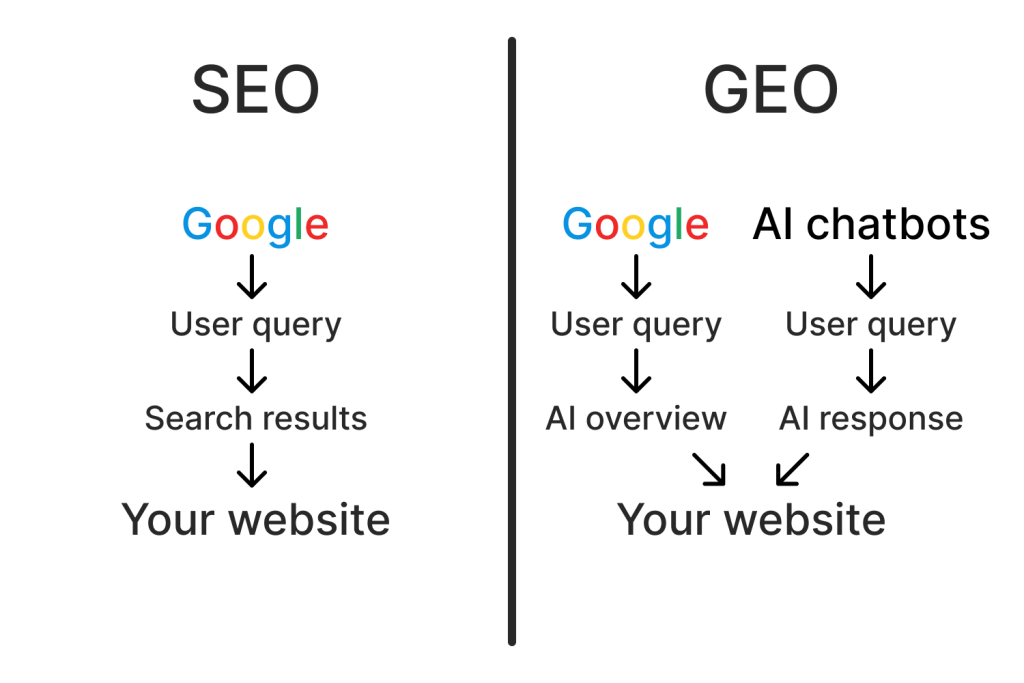
Why Are SEO and GEO Important for a Website?
In the age of AI, SEO is evolving. Every year, users click on search links less often and ask AI more. Still, according to Semrush research, more than 84% of users use traditional search engines every day to find local business information. At the same time, the share of AI platforms in search traffic has grown to 20%, according to a First Page Sage report.
This means that even if your company has social media accounts and updates them regularly, a large portion of traffic still comes (or is lost) through search engines. Also, search engine optimization is an essential foundation for GEO and ranking in AI queries. Even if you don’t plan to appear on Google’s first page for certain queries, but you want ChatGPT to consider you in local search, it’s still worth setting up SEO – you’ll get double the traffic!
How Do Search Engines Measure a Website?
All search engines have standards for measuring SEO. Most look up to the two giants: Google and Bing. In SEO, we often take Google as the benchmark because it gets the majority of search traffic. However, Bing sets the standard for page indexing – most other search engines like DuckDuckGo and Yahoo! Search use its index.
Although Google doesn’t disclose its exact ranking criteria (unlike Bing), according to the experience of millions of specialists, the criteria are similar.
How Google Sees Your Website
We’ll use Google as our example search engine because it’s the most popular one today. Suppose you’ve decided to create a website, read our guide “Does your small business need a website?” and launched it online. How will search engines find it? In most cases, you’ll register with Google Search Console and ask Google to index your site. But there’s another way: if many other sites link to you, Google will find you on its own.
Now your site is indexed, but it doesn’t show up in search results. Why? The answer is simple: search engines don’t yet know if they can trust the information on your site. It just launched, and even if the information is valuable, there’s not enough of it. Most new sites also lack expertise – who you are, how much experience your company has, whether you have reviews, etc. We’ll talk about that later.
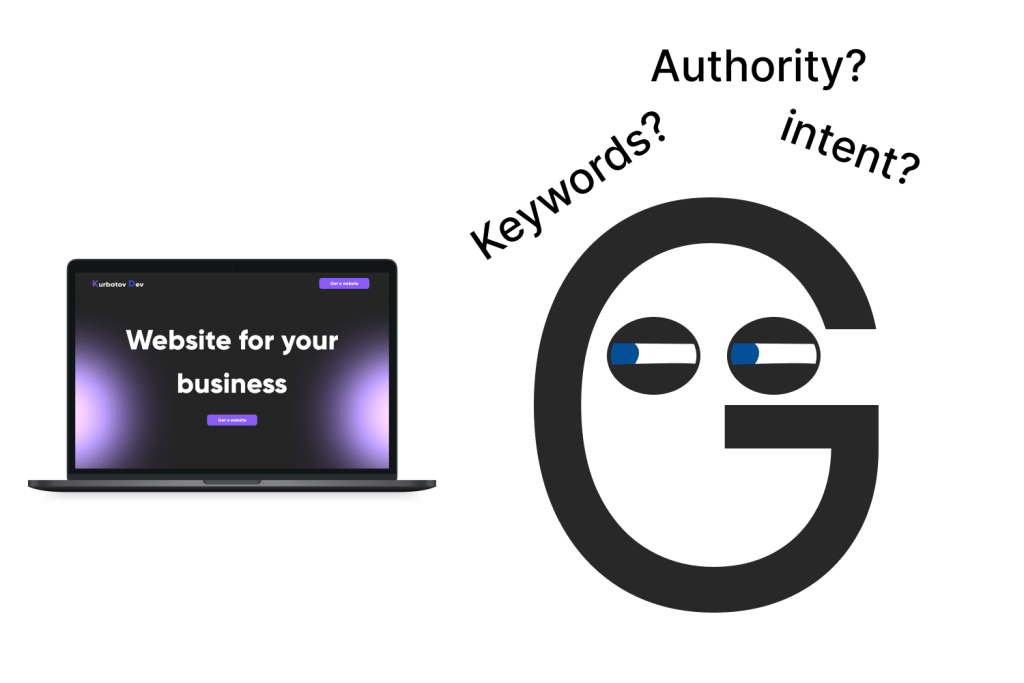
What’s the Difference Between Indexing and Ranking?
Many site owners don’t understand the difference between indexing and ranking. To put it simply: indexing is how a search engine finds your site, and ranking is how high it places your site for a specific query.
Indexing isn’t just about your whole site (“the search engine has indexed my site, now it knows everything about it”). It applies to individual pages too. Search engines re‑index a site hundreds of times a day to see if information has changed or if new pages have appeared. Also, search engines index and rank each page separately. Do you have a blog post that answers a specific user question? The search engine will rank it high for that query, while your homepage might not appear at all for that same query because it’s less relevant.
Keywords and Why They Affect Ranking
We’ve mentioned keywords several times in this article, but what exactly are keywords? Simply put, keywords are words or phrases that appear most often on a site. Search engines evaluate how frequently words or word groups appear, then rank the site according to the category and the user’s search query.
Search engines look not only at the number of specific keywords but also at the context in which they appear. A quality article will rank much higher than a simple collection of words. Moreover, just stuffing keywords without context can lead to penalties or a shadow ban. The most successful content isn’t keyword‑dense content – it’s content that helps users solve their problems and keeps them on the site longer.
In a Nutshell
- SEO helps your site rank higher in Google and other search engines. GEO is about optimizing content for AI answers (ChatGPT, Perplexity, etc.). Both matter for traffic.
- Indexing is when a search engine finds and adds a page to its database. Ranking is the position that page gets for a specific query. They are different processes.
- Keywords are important, but keyword stuffing (repeating a word without context) leads to penalties. Google values useful, well‑structured content that keeps users engaged.
- Even if your site is indexed, it may not appear at the top of search results – search engines need time to assess its expertise, authoritativeness, and trustworthiness (E‑E‑A‑T).
- SEO is the foundation for GEO. By getting the basics right, you’ll get traffic from both traditional search and AI answers.